
Why We Believe the Age of AI Requires a New Management Theory


In July 2026, VURA Capital Innovation Holdings published the complete Future Value Theory series—ten books in total, five in Japanese and five in English.
This publication was never intended to be merely the release of a collection of books.
What we truly wanted to introduce was not a single publication, but a new way of thinking about management in the age of artificial intelligence.
That framework is Future Value Theory.
AI Is Fundamentally Changing the Sources of Competitive Advantage
Generative AI has evolved at an extraordinary pace over the past few years.
Today, AI can write reports, generate images, develop software, review legal contracts, and even support strategic management analysis.
Knowledge and analytical capabilities—once concentrated in specialists and experts—are rapidly becoming democratized through AI.
In other words,
Knowledge
Analysis
Execution
are no longer the unique sources of competitive advantage they once were.
Differences between companies will certainly remain.
However, AI is reducing those differences at a speed unlike anything we have experienced before.
For decades, companies competed by becoming faster, more efficient, and less expensive.
But when AI becomes universally accessible, efficiency alone is no longer sufficient to sustain long-term competitive advantage.
This raises a fundamental question:
What should companies compete on in the age of AI?
That question became the starting point for developing Future Value Theory.
Beyond Traditional Corporate Value
Conventional management has long focused on increasing corporate value.
Increase revenue.
Improve profitability.
Enhance return on equity.
Raise shareholder value.
All of these remain important.
Yet in the age of AI, they are no longer sufficient by themselves.
For example, AI may significantly improve employee productivity.
But does that automatically create a better society?
Does a higher corporate valuation necessarily lead to a better future?
Conversely, if companies pursue corporate value alone, do we risk losing
Employment
Local communities
The environment
Human dignity
These questions led us to reconsider what companies should ultimately seek to achieve.
The Concept of Future Value
Future Value Theory defines Future Value as:
"The shared expectation of society about the future."
Here, "expectation" does not simply mean prediction or optimism.
It refers to a shared belief that a desirable future can be realized through collective action by businesses and society.
The goal is not merely to predict the future.
The goal is to create it.
Companies should not passively wait for the future to arrive.
They should actively participate in shaping it.
When corporate activities contribute to
a more prosperous society,
greater opportunities for people,
and a more sustainable economy,
those companies are creating Future Value.
Future Value Theory therefore does not reject corporate value.
Rather, it reframes corporate value from a broader perspective.
Corporate value remains essential.
However, it should also be understood as a foundation for creating Future Value.
Companies should exist not only to generate profits, but also to contribute to building a better future.
Future Value Theory seeks to answer one central question:
What should become the source of competitive advantage in the age of AI?
As efficiency becomes increasingly commoditized, sustainable competitive advantage will depend on a company's ability to create Future Value continuously.
The Five Elements of Future Value
Future Value Theory argues that Future Value is not created by chance.
Instead, it emerges through the interaction of five interconnected elements:
Purpose
Capability
Capital
Ecosystem
Continuity
These are not independent components.
They function together as an integrated management system.
1. Purpose — Why Does the Company Exist?
Purpose is the starting point of everything.
Why does a company exist?
To generate profits?
To maximize shareholder value?
These objectives certainly matter.
However, they alone cannot explain the true purpose of an organization.
As AI increasingly performs knowledge work and analytical tasks, the role of human leadership shifts toward answering a more fundamental question:
What future are we trying to create?
Purpose represents the future a company seeks to realize for society.
In Future Value Theory, Purpose is not merely a corporate slogan.
It is the guiding principle behind every strategic decision.
2. Capability — The Ability to Realize Purpose
Even the strongest Purpose cannot create Future Value without the capability to execute it.
Capability includes:
People
AI
Technology
Data
Organizational culture
Decision-making
Execution
In the age of AI, Capability also asks how organizations can combine human intelligence with artificial intelligence to create entirely new forms of value.
Future Value Theory views AI not as a replacement for people, but as a force that expands human capability.
3. Capital — Investing Capital in the Future
Capital forms the foundation of every business.
However, Future Value Theory views Capital as far more than financial resources.
Capital includes:
Human capital
Intellectual capital
Brand equity
Trust
Networks
Data
Social credibility
All of these are assets that contribute to Future Value.
Equally important is how capital is allocated.
Rather than directing capital solely toward short-term financial performance, companies should invest in initiatives that create long-term Future Value.
4. Ecosystem — No Company Creates the Future Alone
No company exists in isolation.
Customers.
Employees.
Investors.
Universities.
Startups.
Government.
Local communities.
AI companies.
Global partners.
Corporate value is created through these relationships.
Future Value Theory argues that competitive advantage depends not simply on the strength of one organization, but on the ability of the entire ecosystem to create Future Value together.
AI is making knowledge sharing and collaboration across organizational boundaries easier than ever before.
As a result, the capability to design and cultivate ecosystems becomes a new source of competitive advantage.
5. Continuity — Future Value Must Endure
The final element is Continuity.
Temporary success alone does not constitute Future Value.
The essential questions are:
Can the organization continue creating value for society?
Can it continue adapting?
Can it pass its Purpose to future generations?
The age of AI is defined by constant disruption.
Business models that succeed today may become obsolete within only a few years.
For this reason, Future Value Theory defines Continuity not as maintaining the status quo, but as the ability to continue evolving while remaining true to one's Purpose.
The Five Elements Form a Continuous Cycle
Future Value Theory does not view these five elements as a linear process.
Purpose shapes Capability.
Capability activates Capital.
Capital expands the Ecosystem.
The Ecosystem strengthens Continuity.
Continuity, in turn, deepens Purpose.
The stronger this cycle becomes, the greater an organization's capacity to create Future Value over time.
For this reason, Future Value Theory is not simply another management methodology.
It is designed as an integrated management framework for understanding the enterprise as a whole.
Who Is Future Value Theory For?
Future Value Theory is not designed for a specific industry or company size.
It is intended for all organizations seeking to create the future in the age of AI.
This includes:
Business leaders
Entrepreneurs
Investors
Researchers
Government organizations
Educational institutions
We hope that people from each of these perspectives will interpret, apply, and further develop the concept of Future Value.
Why We Published Future Value Theory as a Ten-Book Series
In July 2026, VURA Capital Innovation Holdings published the Future Value Theory series, consisting of ten books—five in Japanese and five in English.
We intentionally chose to publish the theory as a ten-book series.
There was a clear reason for doing so.
Future Value Theory was conceived not as a single book, but as a body of knowledge for understanding management in the age of AI from multiple perspectives.
Theory Alone Does Not Transform Management
A new management theory, by itself, does not change organizations.
Business leaders must be able to:
Apply the theory to their own organizations
Use it to support strategic decision-making
Put it into practice across their organizations
Continuously refine and improve it
For that reason, we believed a single theoretical volume would not be enough.
Future Value Theory is intended not merely to be read, but to be studied, discussed, and practiced.
Each Book Serves a Different Purpose
The books are not repetitions of the same content.
Each volume plays a distinct role within the overall framework.
Future Value Theory introduces the core concepts and the overall management framework.
Future Value Theory Q&A presents one hundred questions designed to help executives and leaders think critically about management in the age of AI.
Enterprise Redefinition extends the theory into organizational transformation by reexamining the nature of the enterprise itself.
Finally, the two management novels—
Future Value Theory: The Story
Enterprise Redefinition: The Story
translate the concepts into narrative form.
Stories allow readers to experience the dilemmas, decisions, and human dimensions of management that cannot easily be conveyed through theory alone.
Together, these books form a comprehensive knowledge system rather than a collection of independent publications.
Why We Published in Both Japanese and English
Future Value Theory was never intended to be a management theory for Japan alone.
AI is transforming business globally.
The challenges facing organizations are increasingly universal.
For that reason, we published the series in both Japanese and English.
We hope the theory will be discussed, challenged, refined, and expanded across different cultures, industries, and management traditions.
A management theory should never remain closed.
It should mature through dialogue with diverse perspectives around the world.
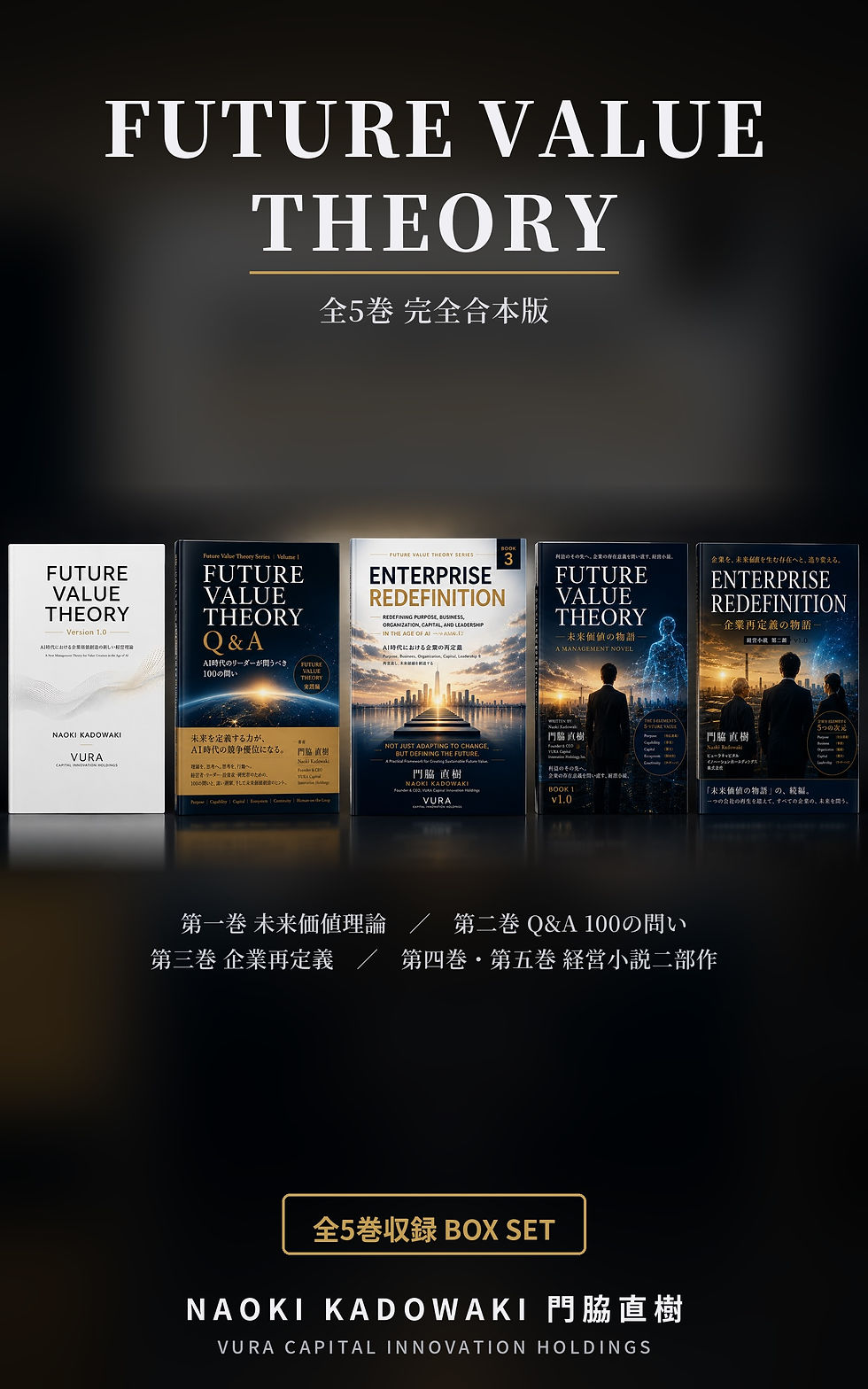
Future Value Theory シリーズ 全5巻合本版: 未来価値理論・Q&A・企業再定義・経営小説二部作(2026年)
『Enterprise Redefinition: AI時代に、Purpose・事業・組織・資本・リーダーシップを問い直す』(2026年)
Future Value Theory ― 未来価値の物語: A Management Novel for the AI Era (2026年)
Future Value Theory: A New Management Theory for Creating Future Value in the Age of AI (2026)
Future Value Theory Q&A: 100 Questions Leaders Must Ask in the Age of AI (2026)
Future Value Theory: A Management Novel for the AI Era (2026)
Enterprise Redefinition: Redefining Enterprise for the AI Era (2026)
Future Value Theory Book Series
Japanese Edition
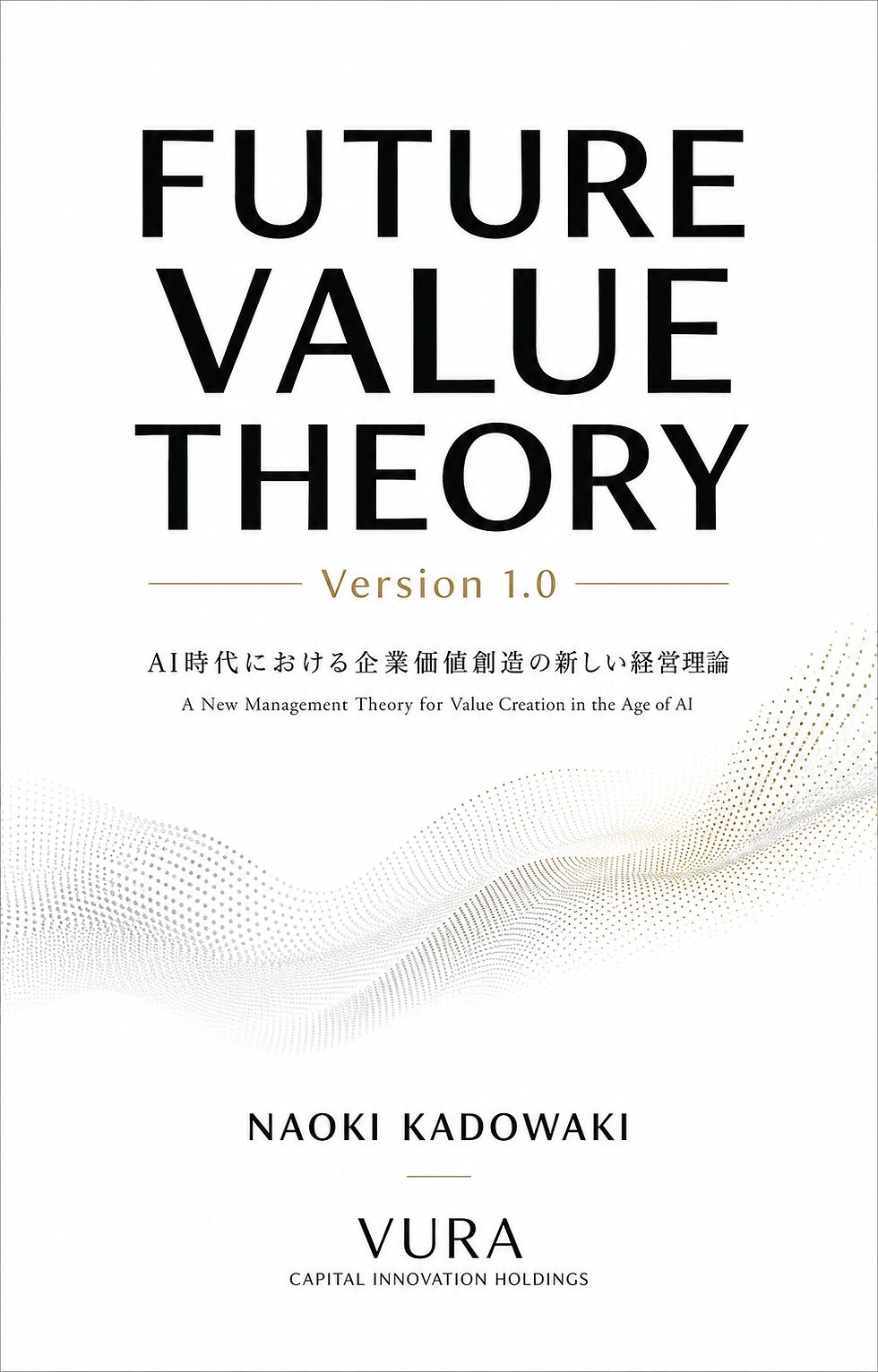
(1) Future Value Theory: A New Management Theory for Creating Future Value in the Age of AI (2026)
The foundational volume of the series.
This book introduces the overall philosophy of Future Value Theory and presents a new management framework built upon five interconnected elements—Purpose, Capability, Capital, Ecosystem, and Continuity—to redefine the roles of business, management, AI, and Future Value.
▶ Amazon: https://amzn.asia/d/03cz75Tw

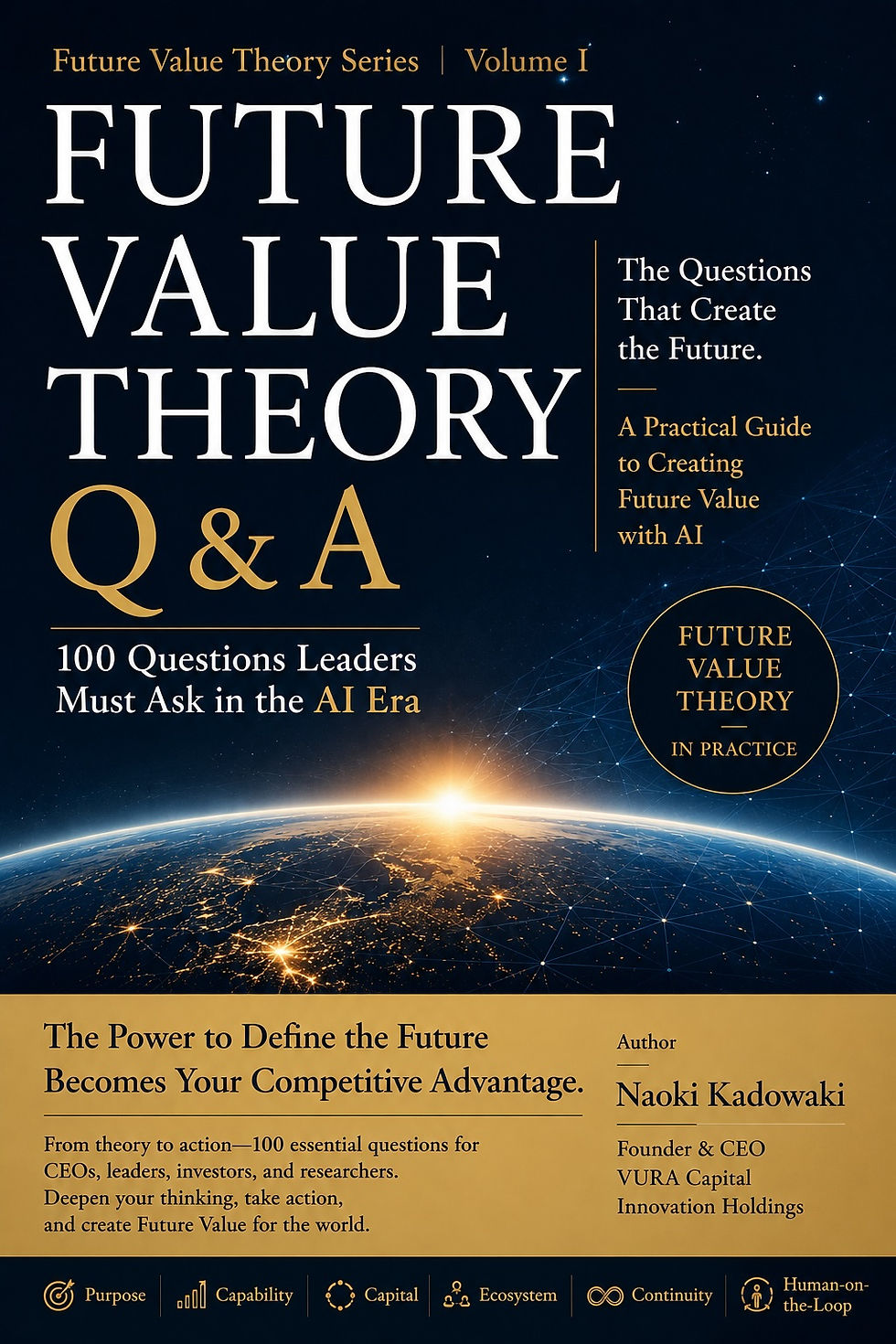
(2) Future Value Theory Q&A: 100 Questions Leaders Must Ask in the Age of AI (2026)
A practical companion containing one hundred questions for business leaders.
Rather than providing predefined answers, the book encourages executives to develop their own thinking about Future Value through inquiry.
▶ Amazon : https://amzn.asia/d/0iRL9p24

(3) Enterprise Redefinition: Rethinking Purpose, Business, Organization, Capital, and Leadership in the Age of AI (2026)
A practical application of Future Value Theory to enterprise transformation.
The book redefines Purpose, Business, Organization, Capital, and Leadership as an integrated framework for creating sustainable corporate value in the age of AI.
▶ Amazon : https://amzn.asia/d/0es5nkay

(4) Future Value Theory: The Story – A Management Novel for the AI Era (2026)
A management novel based on Future Value Theory.
Rather than simply explaining the theory, it allows readers to experience Future Value through the journey of its characters.
▶ Amazon : https://amzn.asia/d/0aSd5zOR

(5) Enterprise Redefinition: The Story (2026)
A companion management novel exploring enterprise transformation.
Through narrative, it asks what organizational transformation truly means and why people are capable of change.
▶ Amazon : https://amzn.asia/d/02b8ZLNL

English Edition
(6) Future Value Theory: A New Management Theory for Creating Future Value in the Age of AI
(7) Future Value Theory Q&A: 100 Questions Leaders Must Ask in the Age of AI
(8) Enterprise Redefinition: Rethinking Purpose, Business, Organization, Capital, and Leadership in the Age of AI

(9) Future Value Theory: The Story – A Management Novel for the AI Era

(10) Enterprise Redefinition: The Story

Future Value Theory: Books 1–5 complete Set
The complete box set brings together the core theory, the Q&A volume, Enterprise Redefinition, and both management novels into a single edition.
English Edition (Amazon.com)

Japanese Edition (Amazon.co.jp)
A Theory Designed to Evolve
We do not regard Future Value Theory as a finished or definitive theory.
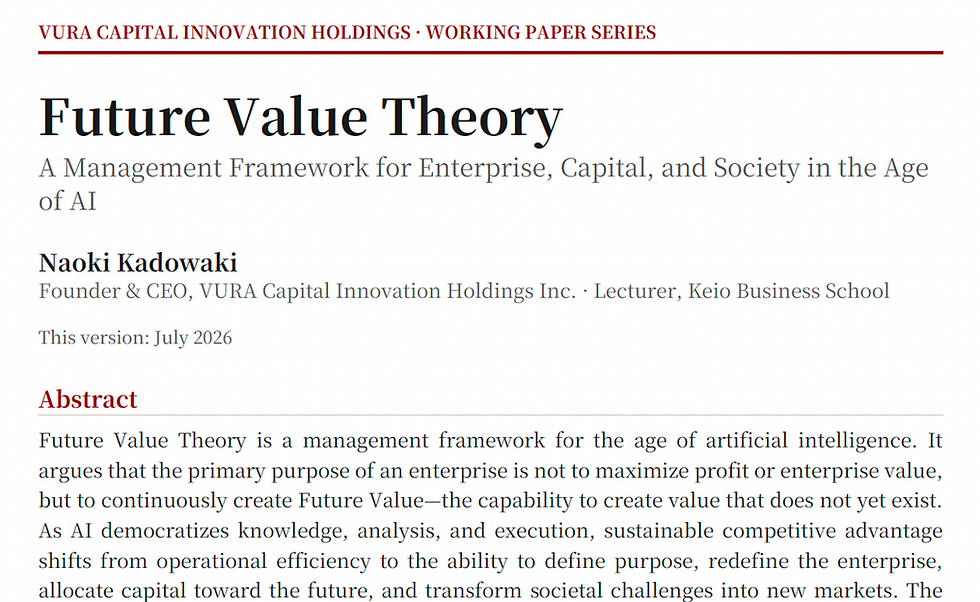
For this reason, we have published its theoretical foundation as a Working Paper.
The Working Paper presents the core concepts and framework as they stand in 2026, while intentionally leaving room for future development through research, practice, and dialogue.
Society changes.
AI continues to evolve.
The environment surrounding business will continue to transform.
Future Value Theory should evolve alongside those changes.
We therefore view this theory not as a fixed doctrine, but as an open framework that will mature through continuous discussion with business leaders, researchers, investors, educators, students, and practitioners.
Future Value Theory is not intended to impose answers.
Rather, it seeks to provide a common language through which organizations and society can continue asking better questions and creating a better future.
The Future That Future Value Theory Envisions
Future Value Theory is neither a theory that simply celebrates AI nor one that rejects traditional management thinking.
Instead, it seeks to offer a new perspective on a fundamental question:
What kind of value should companies create in the age of AI?
Artificial intelligence will continue to advance.
Knowledge will become increasingly democratized.
The boundaries between organizations will become more fluid.
Many business decisions may eventually be supported—or even executed—by AI.
Yet precisely because of these changes, there remains one question that only human beings can ultimately answer:
What kind of future do we want to create?
The responsibility for answering that question belongs not to AI, but to people.
Future Value Theory proposes that this question should become the central organizing principle of management.
What VURA Seeks to Achieve
VURA Capital Innovation Holdings is neither simply an investment firm nor merely a consulting company.
Our mission is to increase the number of organizations that create Future Value.
To achieve that mission, we integrate four activities:
Research and development of Future Value Theory
Support for enterprise transformation
Enhancing corporate value through investment
Practicing new management models for the age of AI
Theory alone cannot change society.
Practice alone cannot produce transferable knowledge.
By continuously connecting theory with practice, we aim to present new approaches to management that are relevant to the challenges of the AI era.
We believe this is the role VURA should play.
Continuing to Ask Better Questions
Future Value Theory is not designed simply to provide answers.
More importantly, it is intended to generate better questions.
The age of AI will present organizations with increasingly complex challenges for which no single correct answer exists.
Success will depend on the ability to ask deeper questions, think from broader perspectives, and consciously shape the future.
We hope Future Value Theory becomes a starting point for dialogue among business leaders, investors, researchers, educators, students, and everyone committed to building a better future.
Future Value Theory is only beginning.
Learn More About Future Value Theory
If you would like to explore Future Value Theory in greater depth, we invite you to visit the following resources.
Future Value Theory Working Paper
The official working paper presenting the theoretical foundation and core framework of Future Value Theory.
Future Value Theory Book Series
A ten-book series covering the theory, Q&A, Enterprise Redefinition, and management novels from multiple perspectives.
Future Value Library
A growing collection of research, publications, essays, and books on management, enterprise transformation, and Future Value creation in the age of AI.
Concept
Learn more about the Purpose of VURA Capital Innovation Holdings and the background behind the development of Future Value Theory.
An Open Invitation
Future Value Theory is an open management theory designed to evolve through collaboration.
We welcome dialogue and collaboration with business leaders, researchers, educational institutions, investors, and practitioners who are interested in shaping the future of management in the age of AI.
Press Release
The publication of the complete ten-book Future Value Theory series was officially announced through PR TIMES.


Comments