
Time with questions that have no answers, in the age of AI — why VURA is sharing 135 artworks and 135 questions

In an age when AI gives us answers, what is the point of spending time with questions that have none? This is why VURA, an investment and management company, decided to share 135 artworks and 135 questions with the world.
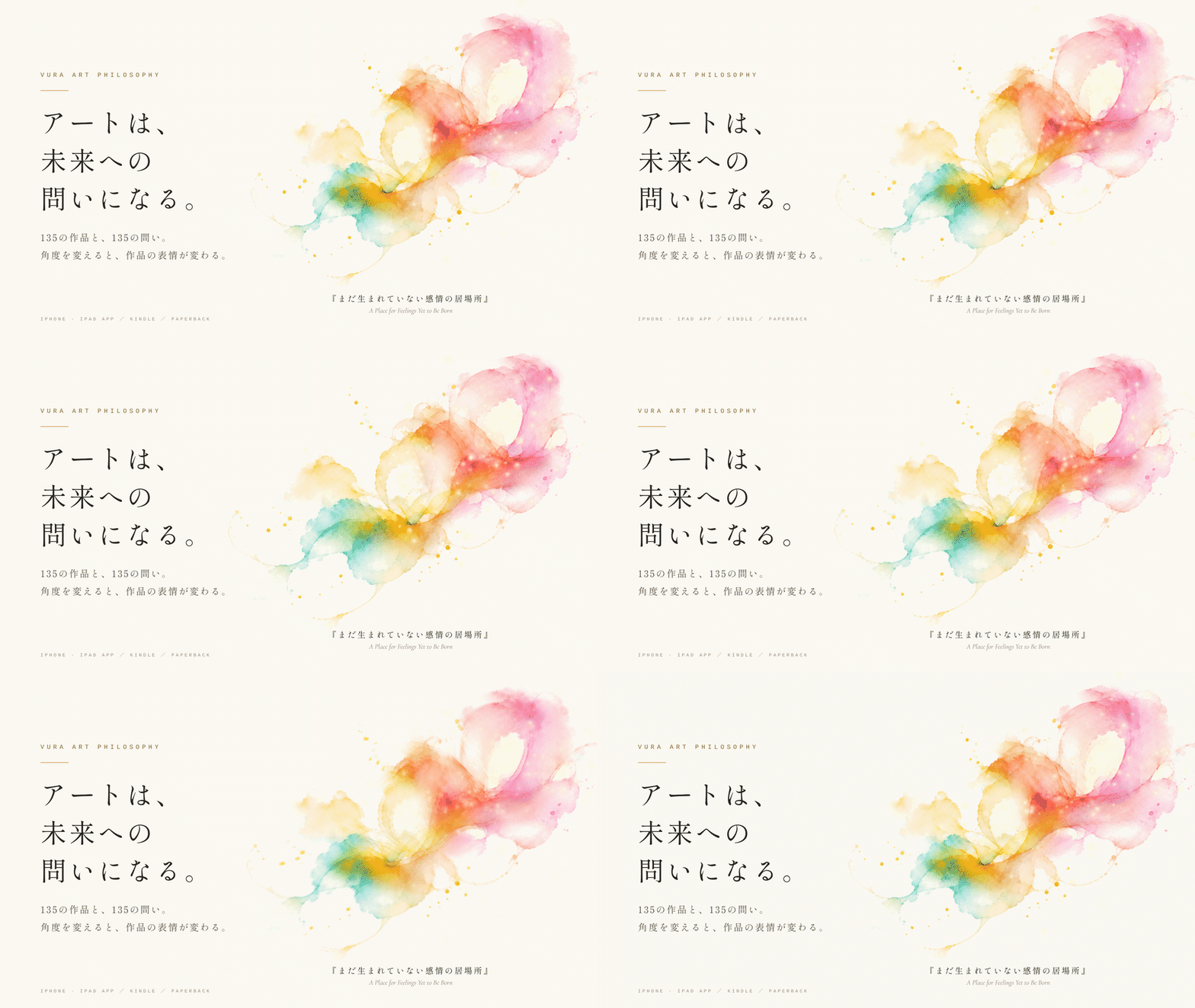
On November 19, 2026, VURA Capital Innovation Holdings Inc. (VURA) released VURA ART PHILOSOPHY, which pairs contemporary art with philosophical questions. Each of the 135 artworks comes with one question. It is available in three forms, in Japanese and English: an app for iPhone and iPad, an e-book on Amazon Kindle, and a paperback on Amazon.
VURA invests in enterprises, steps into their management, and redefines them. Why would such a company turn to art? This article explains the thinking behind it.



What remains when answers are easy to get
AI has made it easy to acquire knowledge and to produce text and images. Look something up, and an answer usually comes back.
Yet some questions never arrive at a single answer. What is happiness? What is freedom? Does inheriting something mean protecting it, or changing it? You can search for these, or ask an AI, but in the end you have to think them through yourself.
Through color, form and empty space, art lets us touch feelings and thoughts before they become words. The moment you stop in front of a work and wonder why it holds your attention is also the moment a question is born. VURA ART PHILOSOPHY aims to offer looking at art and thinking about a question as one experience, each enriching the other.
The same thing is happening in management. AI now handles analysis and document preparation quickly. What is left for executives are questions with no right answer: what are we aiming for, and what do we hold dear? For people and for enterprises alike, the ability to keep holding a question matters more than the ability to produce an answer.
That ability does not appear overnight. It grows from pausing a little each day to think about things that have no quick answer. Could art support that time? VURA ART PHILOSOPHY began there.
135 artworks, 135 questions
The collection consists of a prologue and five series.
Prologue, "Things Not Yet Born" (35 works): things that have neither a name nor a form yet
"The Future of Life" (20 works): life, evolution, existence, regeneration
"The Future of the Earth" (20 works): nature, the environment, living together with the Earth
"The Future of Humanity" (20 works): happiness, freedom, emotion, intelligence, empathy
"Adventure into the Unknown" (20 works): space, time, dimensions, inquiry
"Creating Future Value" (20 works): creation, possibility, choice, inheritance
Each artwork carries one question. "What Blooms After Destruction," in The Future of the Earth, asks whether what is born after something breaks can take the place of what was lost. "Beyond Solitude," in The Future of Humanity, asks whether solitude means losing connection, or coming to know it.
"A Constellation That Does Not Exist," in Adventure into the Unknown, asks whether constellations are in the sky or in the mind of the person looking. "A Market That Does Not Yet Exist," in Creating Future Value, asks whether people already want something that no one has yet said they want.
We do not explain what the works mean. A question is not a doorway to an answer; it is a place to start thinking. Two people looking at the same work will arrive at different answers, and we wanted to respect that difference.
Questions are close at hand
The questions use no difficult philosophical terms. We chose words that might come to mind in everyday life and work. Here are a few more of the works.
"A Place for Emotions Not Yet Born": can an emotion we have not yet experienced still change us?
"An Organ That Does Not Yet Exist": will our future selves sense the world through senses we do not have today?
"A Quiet Warning": can we notice the danger hidden in something beautiful?
"Symbiotic Intelligence": when we think together with AI, who is doing the thinking?
"The Inheritance of Value": is to inherit to protect, or to change?
The 100th work, "The Future Starts Here," asks what question you will hold after a hundred questions. We wanted the last work to be the start of your own question, not an ending.
Seeing in three dimensions
In the app, each work appears as a three-dimensional object with depth. Turn it slowly with your finger and it shows a different expression from each angle. A work that looks calm from the front has another face from the side. Not judging a thing from one angle alone: we believe that sense is itself a way into philosophy.
We kept on-screen text to a minimum and used symbols so the app can be operated by intuition. There are three ways into the works: "Journey," "Feelings" and "The Author's Thoughts." You can also choose a work by your mood that day, such as "tired," "want to calm down" or "anxious about what lies ahead."
The app switches between Japanese and English automatically, following your device settings.
AI as the tool, people as the ones who decide
The works were made with image-generation AI. The themes, questions, composition, colors and direction of expression, however, were decided by Naoki Kadowaki, Representative Director, President & CEO, who evaluated and selected the generated images one by one.
AI widens the means of making. Deciding what to ask and what counts as beautiful remains a human task. This is the same view VURA has formed in management: the more execution AI takes on, the heavier the role of the people who set purpose and values. This body of work is also an attempt to test that view in the form of art.
Available in three forms
App (iPhone and iPad): free to download, with the first work free to view. The remaining 134 works open with a single in-app purchase of ¥3,000 (tax included) in Japan.
E-book (Amazon Kindle): English edition US$16.99; Japanese edition ¥2,480 (tax included).
Paperback (Amazon): 21.59 × 21.59 cm, 314 pages, full color. English edition US$59.99; Japanese edition ¥5,478 (tax included). The closing section, "Another Perspective," revisits twelve representative works from a different angle.
The app is available on the Apple App Store in 13 countries and regions: Japan, the United States, the United Kingdom, Canada, Australia, New Zealand, India, Singapore, Malaysia, the Philippines, Hong Kong, Switzerland and Norway.
Management, too, begins with a question
When VURA takes on an investment or an enterprise transformation, it begins with questions. Why does this enterprise exist? What will it create from here? Facing these before the numbers and the plans is the starting point for redefining an enterprise.
Looking for value that does not yet exist is common to management and to art. The five educational games of VURA BrightMorrow, our next-generation education brand released in November, also start from children's curiosity. A child's "why?", an executive's "what for?" and the wordless question that surfaces in front of an artwork all grow from the same root: the power to create the future. That is how VURA sees it.
We hope executives and business leaders will pick it up as well. Look at one work before a meeting and talk briefly about its question. That alone creates a moment to confirm what the business is for, before the talk turns to numbers. The question of "The Inheritance of Value" speaks to those thinking about succession. The question of "A Market That Does Not Yet Exist" speaks to those thinking about a new business. A question means different things depending on where you stand.
A note from our CEO
Kadowaki says he loves contemporary art because it questions what we take for granted and shows us a future not yet seen. He believes philosophy and art will matter more and more if people are to live as people in the age of AI.
He hopes people around the world will experience the moment where philosophy and art meet, and take strength from it for tomorrow. VURA ART PHILOSOPHY was planned with that hope.
At the end of a busy day, open just one work and take one question home with you. We would be glad if you used it that way.
Links
About: VURA ART PHILOSOPHY
Paperback: English edition / Japanese edition
Press release (Japanese): PR TIMES


Comments