
Brain Capital Management
Why the AI Era Demands Brain Capital Management
AI Is Redefining Human Intelligence as the Core of Enterprise Value
Brain Capital Management (BCM)
From an era of memorizing knowledge,
to an era of leveraging AI,
and transforming human intelligence into enterprise value.
In the age of AI, one of the most fundamentally redefined entities is the human brain itself.
As AI democratizes knowledge, analytics, and optimization, the essence of corporate competitiveness is shifting away from “how much AI a company adopts” toward “how effectively humans can create uniquely human value while leveraging AI as an external brain.”
VURA Capital Innovation sees this transformation not merely as an extension of traditional human capital management, but as:
“The Redefinition of the Human Brain”
and,
“The Redefinition of Enterprise Value itself (Enterprise Redefinition).”
What is Brain Capital Management?
Brain Capital Management (BCM) is a new management model that views the very functions of the human brain — such as empathy, creativity, and curiosity — as core strategic capital that generates enterprise value.
It is not simply another form of human capital management.
It is,
in the age of AI,
the redefinition of:
“the human brain”
and,
“enterprise value itself.”

Why Now
Why Brain Capital Management Now?
“Brain Capital” is a concept that views brain health, cognitive capability, creativity, and intellectual capacity as core strategic capital for future economic growth and enterprise value creation.
Since 2011, international institutions such as the OECD, along with academic communities, have been advancing Brain Capital as a new economic framework integrating neuroscience, economics, education, and investment.
As the global movement toward a “Brain Capital Grand Strategy” accelerates, VURA Capital Innovation defines the essential value of the human brain in the AI era across the following three domains.
Three Human Values
Emotional Human Connection
Deep human relationships created through empathy, trust-building, emotional understanding, and authentic human connection.
Foundational Exploration into Uncharted Domains
The curiosity to create from zero to one, and the creativity to conceptualize and systematize entirely new technologies, ideas, and possibilities.
Producing New Value for Society
Creative production that integrates business, technology, and capital to connect new forms of value into society.
The Three “B”s of BCM
Brain Capital Management is a management model that supports the human intelligence capable of generating empathy, exploration, and creation through organizational, economic, and growth foundations.
Belonging
Belonging represents organizational connection built on psychological safety and empathy, enabling individuals to challenge themselves through their own will and initiative.
Even in the age of AI, human creativity and curiosity are cultivated through deep trust and authentic human relationships.
Base
Base represents the cognitive and economic foundation necessary for people to focus on thinking, challenging, and creating with stability and confidence.
VURA believes that building environments where individuals can expand their capabilities over the long term — through wage growth and investment in human development — is an essential foundation for forming Brain Capital.
Build
Build represents the continuous self-growth process of learning, expanding knowledge and experience, and extending human potential while leveraging AI as a partner.

Brain Capital | The Accumulation of Human Intelligence
At VURA Capital Innovation, the core strategic asset formed and accumulated through Brain Capital Management (BCM) is defined as “Brain Capital.”
Brain Capital refers to the collective foundation of people, organizations, and intellectual infrastructure capable of autonomously creating value while leveraging AI at a highly advanced level.
From an era in which companies themselves held competitive advantage,
to an era in which
“organizations that accumulate Brain Capital”
hold competitive advantage.
VURA seeks to present a new growth model for the AI era by transforming Brain Capital into enterprise value.
Smart Brain
At VURA Capital Innovation, the ideal human model that embodies Brain Capital is defined as the “Smart Brain.”
A Smart Brain is a form of human intelligence capable of empathizing, exploring, and creating while leveraging AI as an “external brain.”
Rather than depending on AI, it continuously expands human potential through co-creation with AI.
Neuroscience
Toward “Evidence-Based Management” Grounded in Neuroscience
VURA Capital Innovation aims to build a new management model that applies insights from neuroscience to maximize human empathy, creativity, and curiosity.
Rather than focusing solely on skill-based training, VURA seeks to build organizational foundations with resilient intelligence by accumulating each individual’s “Cognitive Reserve,” enabling stability even in rapidly changing market environments.
VURA also views co-creation with AI as an opportunity to stimulate neuroplasticity within the brain, transforming the changes of the AI era into energy for organizational growth.
BCM is Human Redefinition.
BCM is not simply talent development.
It is,
in the age of AI,
the redefinition of:
“the human brain”
and,
“enterprise value itself.”
Related Concepts
-
Enterprise Redefinition (ER)
-
Future Value (FV)
-
Value Velocity (VV)
-
Self-Defined Society (SDS)
-
Redefinition Capability (RC)
-
Dual Activism (DA)
-
AI Foundry Japan (AFJ)
A firm-level theory of cognitive capability, its three constraints, and its measurement in the age of AI
Brain Capital Management (BCM) is the practice of measuring a firm's thinking capacity as a capital stock, not as a welfare line item, and managing it as such. The paper calls that capital Brain Capital: the stock of cognitive capability a firm can actually bring to bear on redefining its own future.
The paper's strongest claim fits in one line. What is linked to value is the measured state of the workforce, not spending on well-being programs.
VURA Working Paper No.5. This page explains the main points; the full paper (English original, 90 pages; Japanese edition, 82 pages) is linked at the end.
This paper in three minutes
-
Value is linked to state, not spending. Well-being programs fail almost across the board under rigorous testing; measured levels of workforce state have been linked to stock returns
-
Brain capital has two terms. Capability accumulated in people (stock, K) and the share the organization lets reach the work (utilization, u). They move at different speeds
-
The three Bs (Belonging, Base, Build) are not "three good things." They partition the places where capability is lost. The failure modes are silence, depletion, and decay. They multiply rather than add: investing in one while another is missing yields no gain
-
The biggest finding is a measurement gap. No disclosure regime requires a single measure of the workforce's cognitive or psychological state, so brain capital cannot be priced from public information
-
The paper treats the evidence most favorable to VURA most harshly. It states openly that no instrument yet exists to measure Build
What Brain Capital Management is, in three lines
Brain Capital Management measures a firm's cognitive capability (its thinking capacity) as a capital stock, and designs the organizational mechanisms that determine how much of it there is. It deals with three things: (1) the capability accumulated in employees, (2) the share of it that reaches the work, and (3) the organizational conditions that set that share. Spending on training or programs is none of these.
The definition of a firm's brain capital
Definition | A firm's brain capital The stock of cognitive capability a firm can actually bring to bear on redefining its own future. It consists of the brain health and brain skills of the firm's members, net of the organizational conditions that prevent that capability from reaching the work.
The decisive word is "net." A firm does not own its employees' cognitive capability outright. It owns only the part its own mechanisms allow to reach the work. Two firms hiring the same people can hold different amounts of brain capital. Brain capital is not a hiring outcome. It is a management variable. Measuring it and changing the structures that produce it is Brain Capital Management. Buying programs is not.
An analogy: a gym membership versus a fitness test
Your fitness is not what you pay the gym. It is your measured grip strength and cardiovascular numbers. Double the fee and, if you never go, the numbers do not move. A firm's brain capital is the same: not how much was spent on training, but the measured state of the employees. That is Proposition 1.
How this differs from the "Brain Capital" discussed by international bodies
The term "Brain Capital" is not VURA's invention. As an asset concept combining brain health and brain skills, it has developed mainly through international bodies as a national, population-level asset (Smith et al., 2021; Eyre et al., 2021, Neuron). The paper did not borrow the term; it redefined it as a firm-level asset.
The paper sets out the difference from neighboring concepts in a seven-dimension table, a test of discriminant validity (whether a concept is genuinely distinct from its neighbors). Population-level brain capital overlaps on three dimensions (accumulated stock, health, skills) but has no utilization term (availability as a measured state), no voice and transmission, and no design-conditioned depreciation under AI. Human capital (Becker, 1962; Mincer, 1958), organizational capital (Eisfeldt & Papanikolaou, 2013), and psychological safety (Edmondson, 1999) each occupy a different combination.
The table shows non-coincidence, not superiority, and it is falsifiable at the level of specification: if any neighboring concept can absorb all seven dimensions, the paper's claim collapses.
One more note. The figures that circulate in this field, "267 million DALYs" and "$6.2 trillion" (a DALY is a measure of healthy life-years lost to illness or disability), trace back to an estimate that assumes 90% adoption and calls itself "aspirational." The paper does not use figures of this kind as evidence.
The starting point: a paper cannot be built on "three good things"
In a press release of 21 May 2026, VURA proposed Brain Capital Management as three Bs: Belonging, Base, and Build. Turning this into a paper meant facing a fact: written as "three good things," the paper would be killed by the evidence. So it was built not from supporting evidence but from the counter-evidence. This is its main contribution.
The counter-evidence: well-being programs fail almost across the board under rigorous testing
-
A cluster-randomized trial (worksites, not individuals, drawn by lot) of 32,974 people at 160 worksites found significant differences on only 2 of 40 pre-registered outcomes, both self-reported (Song & Baicker, 2019, JAMA)
-
An individually randomized trial of about 5,000 people found no effect on medical spending, health behaviors, or productivity, and rejected 84% of prior estimates at the 95% confidence interval. The positive correlations came from selection bias: healthier people had been signing up (Jones et al., 2019, QJE)
-
A propensity-score analysis of 46,336 people (participants matched with similar non-participants) found that those who took training or used apps were no better off (Fleming, 2024, IRJ)
On the other side, levels (states) are linked to value. A portfolio of the "100 Best Companies to Work For" earned an abnormal return of 3.5% a year from 1984 to 2009 (a four-factor alpha: the return left after known drivers such as firm size are removed) (Edmans, 2011). Organizational capital is priced too (Eisfeldt & Papanikolaou, 2013).
No contradiction. Measuring a state and buying an intervention are different things.
Proposition 1 | State, not spending Brain capital is value-relevant as the measured state of the workforce, not as a flow of program spending. Falsification condition: evidence that program spending predicts redefinition or value outcomes after controlling for measured state, or that the incremental predictive power of state disappears once spending is controlled for.
In plain terms — How much was spent on what has no bearing on value. Only the actual state of the employees does.
Stock (K) and utilization (u): why effects arrive at such different times
Brain capital decomposes into two terms.
Term 1 Stock K Capability embodied in people as education, experience, and health Builds slowly, depreciates if neglected, does not move within a quarter Term 2 Utilization u The share of that stock the organization lets reach the work A property of the mechanisms, not of the people, so it moves fast
An analogy: a reservoir and a tap
This is where readers get stuck, so here is an analogy.
Stock (K) is the water in a reservoir. It takes years to fill and evaporates if left alone; this month's effort does not change the level. Utilization (u) is how far the tap is open. However much water there is, a closed tap delivers nothing, and the tap can be turned today. What you can use is volume × opening.
The decomposition explains an odd time lag in the evidence. Change the timing of wage payments and the effect appears within one pay cycle (the tap, utilization, is a property of the current period). The effect of capability development shows up only two or three years later (the water, the stock, accumulates across periods). A framework that does not separate the level equation (how much is there now) from the law of motion (how it rises and falls) gets both wrong.
It also draws a portrait of a dangerous firm. One that runs the tap fully open while draining the reservoir keeps looking strong until the day that capability is actually needed.
The three constraints (the three Bs): not "three good things" but a partition of failure locations
For an individual's cognitive capability to become the firm's, three conditions must hold in sequence. The capability must exist and be maintained. It must be available at the moment of work. And it must be transmitted to the organization. The failure modes are decay, depletion, and silence, and the three Bs are the conditions that guard these three locations.
Here the paper, responding to peer review, deliberately weakened its completeness claim. What the three Bs exhaust is not the causes but the locations. Sleep, workload, information overload, leader behavior, incentive design: all are causes, and each acts at one of the three locations (sleep and the like at Base, leader behavior at Belonging, AI design and practice at Build). Falsification condition: an empirical case of a firm-actionable condition that bounds the conversion without acting at any of the three locations.
Belonging: stopping silence, not generating ideas
An organization cannot act on what it cannot hear. The concept that captures this is psychological safety: a team's shared belief that it is safe to take interpersonal risks. It is a property of the team, not of individual personality, and it means not comfort but the absence of an interpersonal cost to speaking up.
The evidence here is the thickest of the three constraints, and it defies popular expectation. In a meta-analysis (a statistical pooling of many studies) of 136 samples and more than 22,000 people, the strongest links were to information sharing (correlation 0.52) and learning behavior (0.62). A separate meta-analysis of 162 samples is more telling still: psychological safety strongly reduces silence (−0.44) but only weakly increases voice (0.14). Its correlation with creativity, 0.13, was the smallest of all.
Proposition 2 | Transmission, not generation Belonging raises brain capital by reducing the suppression of cognitive contributions that already exist, not by increasing the generation of contributions. Falsification condition: in a design that separates the two, an association with novel idea generation equal to or greater than the associations with information sharing and silence.
In plain terms — It is not a device for producing new ideas. It is a device for stopping insights that already exist from disappearing unsaid.
Two qualifications apply. First, the relationship is not monotonic. Moderately safe workplaces perform well; at very high levels performance falls, and what prevented the fall was collective accountability. If that accountability targets task compliance, it degrades into surveillance and destroys belonging. A Purpose Description, which defines roles by purpose and principles of judgment, is the form in which the two coexist.
Second, an intervention is no substitute for structure. In a large randomized trial of 26,911 people at 22 institutions, belonging interventions worked only where the environment already offered a foothold. Running psychological-safety training in a company where dissent stops promotions is spending, not investment.
Base: only material circumstances work, not information
What a firm acquires through an employment contract is a person's time, not their attention. Debt that cannot be repaid, a sick family member, unstable housing: unresolved material circumstances occupy cognitive bandwidth (the total attention a person can deploy at once) during working hours too.
The paper starts by questioning a famous number. The study claiming "poverty lowers IQ by about 13 points" (Mani et al., 2013a) was widely cited, but the figure was an arithmetic rescaling of an effect size. A direct replication (n=417; González-Arango, 2022) failed, and a Bayesian meta-analysis pooling 14 effect sizes found g=0.09 [−0.03, 0.21], effectively zero (Szecsi & Szaszi, 2024).
The stronger evidence comes from a different design. In Indian manufacturing, 408 piece-rate workers were randomly assigned to receive wages they had already earned earlier, with no change in amount (Kaur et al., 2025, QJE). Workers paid early repaid debts, output rose 6.9% (0.109 SD, p=.020), and errors fell (attentional accuracy +0.17 SD; SD, standard deviation, expresses an effect as a multiple of the natural spread). Among workers below median wealth the effect was 13.0%. The decisive detail: merely announcing the payment had zero effect (0.014 SD, p=.685). Settling debt accounts also improved cognitive function by about 0.25 SD, regardless of the amount forgiven (Ong et al., 2019).
But not everything material works. A precise experiment that extended measured night-time sleep by 27 minutes produced −0.00 SD on cognition, no effect at all (Bessone et al., 2021, QJE). The experts' prior forecast of +7% was rejected at p<.001.
Proposition 5 | Material–informational asymmetry Base interventions raise brain capital when they resolve unsettled material claims on workers' attention, and not when they change information about those claims or offer voluntary programs. Falsification condition: in a randomized design, an informational or voluntary-program intervention of equal cost producing cognitive and output effects that match those of a material intervention.
In plain terms — Telling people "a helpline is available" does not work. Only removing the claim itself, the one occupying their head, works.
Proposition 5 is a claim about workforces that include liquidity-constrained workers (chased by payments, short of cash). For professional workforces it is kept as a hypothesis with a specified test procedure. Proposition 6 states that the returns concentrate in the lower tail of the distribution, and average measures systematically understate scarcity. The informative figure is the bottom decile, not the mean.
Build: design, not dose, determines the sign
Evidence on AI productivity is abundant, but almost all of it measures the assisted state, people with the tool in hand: +15% (n=5,172; Brynjolfsson et al., 2025, QJE), −40% time required (Noy & Zhang, 2023), +26.08% (n=4,867; Cui et al., 2026, Mgmt Sci). Outside the frontier of what the tool does well, one study reports −19 pp (percentage points) (Dell'Acqua et al., 2026a).
The problem appears when unassisted capability is measured.
-
A group with unrestricted access scored +48% with assistance but −17% on an unassisted test. The group given guardrails showed zero harm (Bastani et al., 2024)
-
No advantage in transfer of learning (metacognitive laziness: with AI at hand, people skip checking their own understanding) (Fan et al., 2025, BJET)
-
At four centers in Poland, 19 endoscopists averaging 28 years of experience saw their adenoma detection rate without AI fall from 28.4% to 22.4% (−6.0 pp [−10.5, −1.6]; Budzyń et al., 2025, Lancet Gastro). Note: an observational study; it does not establish causation
-
Self-reports point the other way. Developers were 19% slower, yet believed they had become 20% faster (METR; Becker et al., 2025)
There is contrary evidence too. A pedagogically designed tutor outperformed in-class active learning (Kestin et al., 2025, Sci Rep). The dividing line was design, not dose.
Proposition 8 | Design determines the sign of net capability change The pedagogical design of AI adoption (guardrails, tutor-type structure, protected tool-free practice) determines the sign of the net change in the unassisted capability stock (ΔK). Adoption intensity does not.
In plain terms — "How much AI we rolled out" does not decide whether employees' underlying ability rises or falls. How it was rolled out does.
The paper's own reservation matters. The range claimed for ΔK runs from negative to approximately zero. The paper does not claim that workplace AI adoption, under any design, raises unassisted capability. The most a good design can do is stop underlying ability from shrinking. Proposition 9 states that self-report is unfit as a measure of Build; the bias in self-assessment persists even after direct experience.
The three Bs multiply; they do not add
Proposition 11 | Multiplicative level and dynamic stock A firm's brain capital is the product of the stock and two bounded utilization rates (Belonging and Base). The third constraint (Build) enters not the product but the law of motion of the stock. Investment in one constraint while another is severely deficient produces no measurable gain.
In plain terms — If even one is near zero, the whole is near zero. Because it multiplies, raising the others does not bring it back.
This structure predicts the failure of familiar substitutes.
-
A firm that answers financial hardship with listening sessions and empathy training, leaving pay structure untouched → the binding constraint is Base, but the investment goes to Belonging. Zero result
-
A firm that raises pay but builds no channel for dissent → fails symmetrically
-
A firm that calls expanding AI rollout a capability strategy → assisted output rises, tool-free capability is neglected, and self-reports say things are improving, so no one notices
The order of discovery has a structure too. Base tightens first, yet shows up in no metric (a worker in hardship shows up, complies, even looks keen). Belonging failure is the most misdiagnosed, because silence cannot be counted. What should be measured is silence, not satisfaction. Build failure is the slowest to surface. The order of investment follows: Base first, development after.
An asset you cannot measure, you cannot protect: measurement asymmetry
This is the paper's central observation and its largest original contribution. In a 32-row inventory of metrics, it lays out what disclosure regimes actually require.
Metric categoryCurrent treatment
Rows 1–21 | Mandated, audit-assured human-capital metricsInputs, costs, demographics, hazards, and statements of policy only
Rows 22–30 | WHO-5 / 4-item well-being / UWES-9 / Edmondson PS-7 / Belonging at Work Scale / WHO HPQResearch use only, unaudited, outside every disclosure regime
Row 31 | Unassisted cognitive capabilityNo firm-level instrument exists
Row 32 | Organizational capitalThe only priced measure. But it draws on no human-capital disclosure: investors compute it themselves from the financial statements
The regulatory position is documented from primary sources. The US rule names only one metric: headcount. The EU's revised ESRS (adopted 3 July 2026) cut mandatory datapoints by more than 60%. ISO 30414:2018 was withdrawn on 25 August 2025, and the ISSB's human-capital project remains at the research stage. Japan's Cabinet Office Ordinance of 20 February 2026 is among the most substantive, yet even it contains not one validated measure of the workforce's cognitive or psychological state.
Proposition 12 | Measurement asymmetry A firm's brain capital is systematically unpriceable from public information, and the dimensions of enterprise redefinition that depend on it are unobservable to capital markets. Falsification condition: a mandatory, audited disclosure requirement in a major jurisdiction for a validated measure of the cognitive or psychological state of the workforce.
In plain terms — Investors do not simply not know about brain capital. They have no way of knowing. The numbers do not exist anywhere.
This supplies the reason for a finding in Enterprise Redefinition Observed. In that analysis of 18 firms, 27 of 90 cells could not be judged, and 67% of them (18 cells) were concentrated in the organization and leadership dimensions. That observation asymmetry was not a limitation of the research design but a missing reporting infrastructure. It is also the source of the invisibility Redefinition Capitalism means when it says capital does not see redefinition capacity.
The three-layer measurement architecture: sorting metrics by how hard they are to fake
The prescription is not "disclose more." It is to sort metrics into three layers by how they are generated and how hard they are to fake. This is the three-layer measurement architecture.
Layer 1 | Anchors — Certified sickness absence, work-related ill health (GRI 403-10), disability-leave incidence, regretted attrition, internal fill rate, training hours, year-on-year change in average pay. Hard metrics generated automatically by management systems and already inside the audit perimeter. They do not measure brain capital. They are the check that keeps Layer 2 honest.
Layer 2 | State — Validated instruments administered by a third party under near-census conditions. Belonging is reported as the share of teams below a threshold on a psychological-safety scale; Base as the bottom decile (the value at the lowest 10%) of a well-being measure and the share below the WHO-5 cutoff. Distributions, not averages, because scarcity hides in the tail. Response rates are disclosed alongside. PHQ-9 and GAD-7 are deliberately excluded: they are legally sensitive health records, their validity when aggregated by organization is untested, and they can be gamed toward under-reporting when things get worse.
Layer 3 | Mechanism — Disclosure of structure, not policy or intent. Wage-payment frequency and timing policy, draw-down rates on hardship liquidity facilities, dissent channels and how often they are used, AI pedagogical design, promotion criteria, defended-time mechanisms. One entry rule applies. Only mechanisms that carry a quantity reconcilable against records kept for another purpose (payroll, finance, HR, access logs) qualify for Layer 3a. Anything that cannot be reduced to a quantity may be disclosed only in Layer 3b, on condition that the full procedure is published and an independent third party certifies the process.
Why such elaborate defenses? Because the moment a measure becomes a target, it degrades. The worse a firm performs, the more its disclosures drift toward boilerplate and optimistic tone (Demers et al., 2026). The line of defense is the anchors, not self-report. A firm that reports improving well-being while certified sickness absence and regretted attrition rise has disclosed an internal contradiction detectable without reading a single survey response.
The proposal to standard-setters is surprisingly small. Add just two figures: the share below the WHO-5 cutoff and the bottom decile of the 4-item scale. That alone brings rows 22–26 of the table above inside the disclosure perimeter. Three conditions attach: response rates disclosed at the same time, third-party collection, and Layer 1 anchors reported alongside. Building on the 2026 Cabinet Office Ordinance and the Ito Report for Human Capital Management, the paper argues that Japan could be the first jurisdiction to adopt it.
What the paper admits it cannot yet show
VURA's theory pages do not omit the limitations a paper states about itself.
Construct validity (whether a concept really points at what it claims to measure). A reviewer asked whether brain capital is "just human capital × organizational conditions," a utilization model. The paper accepts the challenge as legitimate, answers it, and keeps a concession on the record: "Taken alone, the utilization term (u) is a utilization model of human capital." The claim to distinctness rests on the conjunction (all holding at once) of stock × health × utilization × voice × strain × depreciation under AI, not on any single dimension.
Build has no Layer 2 instrument. The provisional substitute, an "unassisted work sample" (people tackling real tasks without AI), reaches only the layer of job performance. No instrument yet exists to measure the "redefinition-related capabilities" (noticing that a business model is failing, formulating the problem, sustaining the argument) that the definition places at the core of brain capital. The paper discloses this gap rather than papering over it with proxies, and specifies the research to fill it: longitudinal measurement over several years, tool-free, with blind scoring.
Appropriability (whether the investing firm can capture the returns). Proposition 10 holds that for general-purpose components a firm captures the return only in proportion to labor-market frictions, and that "a business case claiming both a large productivity gain and a large retention gain from the same investment is internally inconsistent." Firm-specific components, of which redefinition capacity is the primary example, can deliver both.
Conflict of interest. Brain Capital Management is a concept tied to VURA's own business. The paper discloses this structurally and then treats the evidence most favorable to the company most harshly. The "11.6× ROI" of a single anonymous firm, sourced from a vendor white paper, is cited only as evidence of the gap. A study whose authenticity was disowned by the author's institution (Toner-Rodgers, 2024) is not used in the references or the text at all. "Oxytocin, the trust molecule" is cited only as counter-evidence. The vocabulary of "neuroplasticity" is not used either; compounding is argued through absorptive capacity and learning curves.
Implications
For executives. Of your firm's human-capital figures, how many measure a state? Training hours and attrition are not the "state" of Proposition 1. Which of the three Bs is your tightest constraint? Because the relationship multiplies, leaving the weakest link untouched caps everything you invest elsewhere.
For investors. Brain capital is currently systematically unpriceable from public information. Informativeness runs in descending order of verification: mechanism disclosures with quantities reconcilable against records (Layer 3a), process certification alone (Layer 3b), and uncertified statements of policy and intent (which converge on boilerplate).
For policymakers. The addition is two figures and three conditions. Japan is positioned to introduce this disclosure first.
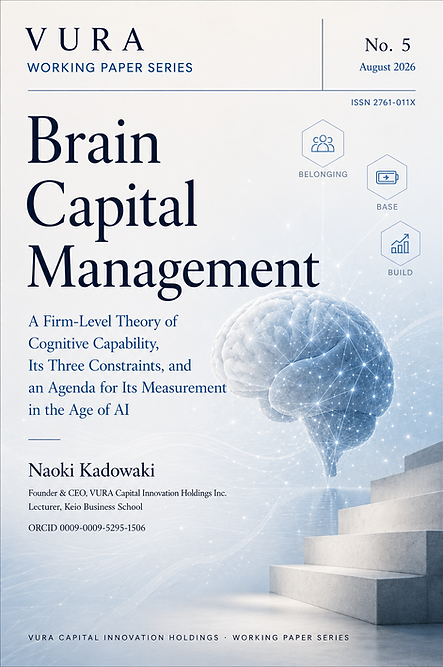
This paper develops a firm-level theory of Brain Capital for the age of AI. It defines Brain Capital as the cognitive capability an enterprise can mobilize to shape and redefine its future. The framework identifies three critical constraints: Belonging, Base, and Build.
It distinguishes AI-assisted productivity from the accumulation of unassisted human capability over time. The paper also proposes a measurement architecture and research agenda for making Brain Capital observable and manageable within enterprises.

No. 5
-
Title: Brain Capital Management: A Firm-Level Theory of Cognitive Capability, Its Three Constraints, and an Agenda for Its Measurement in the Age of AI
-
Version: 1
-
Publish date: August 15, 2026
-
PDF: https://zenodo.org/records/21942227/files/Brain_Capital_Management_WP_v1.8.pdf?download=1
-
SSRN: https://papers.ssrn.com/sol3/papers.cfm?abstract_id=7286918
-
Author: Naoki Kadowaki
-
Publisher:VURA Capital Innovation Holdings Inc.