
Working Papers & Strategic Research
Key Research Themes & Focus Areas
VURA Working Paper Series
ISSN 2761-011X
Publisher: VURA Capital Innovation Holdings Inc.
Place of Publication: Minato-ku, Tokyo, Japan
First Issue: No. 1, July 2026
Publication Frequency: Irregular, at least annually
Format: Online
Access: Open Access

Future Value Theory redefines the source of enterprise value as the capability to create value that does not yet exist.
It positions profit and enterprise value as outcomes, integrating Purpose, Capital, AI, people, and society into a new framework for value creation. The paper proposes a shift from managing to predict the future toward managing to create it.

No. 1
-
Title: Future Value Theory: A Management Framework for Enterprise, Capital, and Society in the Age of AI
-
Version: 1
-
Publish date: July 30, 2026
-
PDF: https://zenodo.org/records/21255663/files/Future_Value_Theory_Academic.pdf?download=1
-
SSRN: https://papers.ssrn.com/sol3/papers.cfm?abstract_id=7120980
-
Author: Naoki Kadowaki
-
Publisher:VURA Capital Innovation Holdings Inc.

Enterprise Redefinition argues that competitive advantage in the Age of AI increasingly depends on the ability to repeatedly redesign the enterprise itself.It presents a framework for continuously re-examining Purpose, Business, Organization, Capital, and Leadership.The paper reframes transformation from an episodic project into a permanent organizational capability for continuous enterprise evolution.

No. 2
-
Title: Enterprise Redefinition: Toward an Enterprise Evolution Theory for the Age of AI
-
Version: 1
-
Publish date: July 31, 2026
-
PDF: https://zenodo.org/records/21718637/files/Enterprise_Redefinition_Academic.pdf?download=1
-
SSRN: https://papers.ssrn.com/sol3/papers.cfm?abstract_id=7210118
-
Author: Naoki Kadowaki
-
Publisher:VURA Capital Innovation Holdings Inc.


No. 3
-
Title: Enterprise Redefinition Observed: A Multiple-Case Analysis of Eighteen Enterprises in the Age of AI
-
Version: 1
-
Publish date: August 8, 2026
-
PDF: https://zenodo.org/records/21850022/files/Enterprise_Redefinition_Observed_WP_v1.2.pdf?download=1
-
SSRN: https://papers.ssrn.com/sol3/papers.cfm?abstract_id=7250421
-
Author: Naoki Kadowaki
-
Publisher:VURA Capital Innovation Holdings Inc.
This paper applies the Enterprise Redefinition framework to eighteen enterprises, including NVIDIA, Microsoft, Amazon, Apple, TSMC, and SpaceX.The analysis shows that sustained redefinition depends less on the frequency of change than on coherence across Business, Capital, Organization, Purpose, and Leadership.A contrast with five failed or forfeited redefinitions further identifies common structures—and vulnerabilities—behind continuous Future Value creation.


No. 4
-
Title: From Job Description to Purpose Description: An Organizational Theory of Dynamic Role Design and Future Value Creation in the Age of AI
-
Version: 1
-
Publish date: August 10, 2026
-
PDF: https://zenodo.org/records/21872816/files/From_Job_Description_to_Purpose_Description_v1.pdf?download=1
-
SSRN: https://papers.ssrn.com/sol3/papers.cfm?abstract_id=7259442#
-
Author: Naoki Kadowaki
-
Publisher:VURA Capital Innovation Holdings Inc.
As AI continuously reshapes the boundaries of work, static Job Descriptions alone are no longer sufficient to define human roles.This paper introduces the Purpose Description (PD), which defines why an individual or team exists, for whom it creates value, and what future it seeks to realize.It proposes a dynamic role architecture for human-AI collaboration while keeping purpose, judgment, accountability, and authority ultimately with humans.
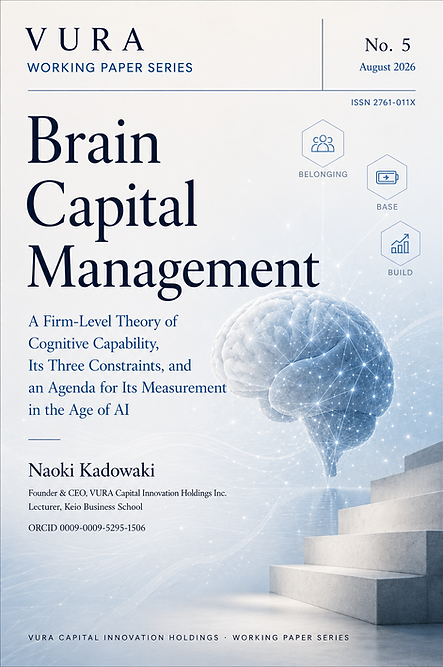
This paper develops a firm-level theory of Brain Capital for the age of AI. It defines Brain Capital as the cognitive capability an enterprise can mobilize to shape and redefine its future. The framework identifies three critical constraints: Belonging, Base, and Build.
It distinguishes AI-assisted productivity from the accumulation of unassisted human capability over time. The paper also proposes a measurement architecture and research agenda for making Brain Capital observable and manageable within enterprises.

No. 5
-
Title: Brain Capital Management: A Firm-Level Theory of Cognitive Capability, Its Three Constraints, and an Agenda for Its Measurement in the Age of AI
-
Version: 1
-
Publish date: August 15, 2026
-
PDF: https://zenodo.org/records/21942227/files/Brain_Capital_Management_WP_v1.8.pdf?download=1
-
SSRN: https://papers.ssrn.com/sol3/papers.cfm?abstract_id=7286918
-
Author: Naoki Kadowaki
-
Publisher:VURA Capital Innovation Holdings Inc.

This paper develops the Self-Defined Society (SDS) as an institutional framework for the age of AI. As AI increasingly commoditizes knowledge work, it explores a shift from value defined by affiliation, credentials, and titles toward self-definition. The paper proposes institutional mechanisms that enable individuals to define their own value while preserving security, belonging, and accountable human authority.

No. 6
-
Title: The Self-Defined Society: An Institutional Theory of Redefinition Capitalism, Autonomous Value Definition, and Societal Redefinition in the Age of AI
-
Version: 1
-
Publish date: August 15, 2026
-
PDF: https://zenodo.org/records/21945635/files/Self_Defined_Society_WP_v1.pdf?download=1
-
SSRN: https://papers.ssrn.com/sol3/papers.cfm?abstract_id=7288018
-
Author: Naoki Kadowaki
-
Publisher:VURA Capital Innovation Holdings Inc.

This paper develops Redefinition Capitalism (RCap) as a capital-allocation framework for future value creation in the age of AI. It argues that the emerging frontier is not simply long-term value, but a firm’s redefinition capacity—its ability to generate new options by redefining what it produces and why. The paper explores how making this capacity measurable could reshape capital allocation toward future value creation.

No. 7
-
Title: Redefinition Capitalism: A Capital Allocation and Macroeconomic Theory of Future Value Creation in the Age of AI
-
Version: 1
-
Publish date: August 15, 2026
-
PDF: https://zenodo.org/records/21945763/files/Redefinition_Capitalism_WP_v1.pdf?download=1
-
SSRN: https://papers.ssrn.com/sol3/papers.cfm?abstract_id=7288021
-
Author: Naoki Kadowaki
-
Publisher:VURA Capital Innovation Holdings Inc.

Research Frontier for a Future Value
Creation Architecture in the Age of AI
Seven Papers Connecting Three Layers: Capital Markets,
Society and Individuals, and Enterprise Management
In an age when AI can generate answers, what remains uniquely human—and what remains for companies to do?
Creating documents has become faster. Analysis and development are increasingly automated. But is that enough for companies to create the future? “What, then, have we become a company that creates?” This book begins with that question. As AI rapidly levels access to knowledge, analysis, and execution, efficiency alone can no longer sustain competitive advantage. What will become scarce is not the ability to solve given problems faster, but the capacity to define: What should be valued? Which future should we choose? Why does a company exist? It is the capacity to define purpose and meaning—and to redraw the existing architecture of business, organization, and capital. This book calls that capacity the power of redefinition. Building on seven research papers published as Nos. 1–7 of the VURA Working Paper Series, this volume presents future value creation in the age of AI as an integrated architecture spanning three interconnected layers.
Author: Naoki Kadowaki (Author)
Kindle
-
ASIN : B0HFFMG2B2
-
Publisher : VURA Capital Innovation Holdings
-
Publication date : Aug 16, 2026
-
Language : English
Paperback
-
ASIN : B0HFFJTNX3
-
Publisher : Independently published
-
Publication date : Aug 16, 2026
-
Language : English
-
ISBN-13 : 979-8192929759
-
Amazon: https://www.amazon.com/dp/B0HFFJTNX3

AI時代の未来価値創造体系を切り拓く研究フロンティア: 資本市場・社会と個人・企業経営の 3層をつなぐ7つの研究論文
AIが答えを生み出す時代、人間と企業には何が残るのか。資料作成は速くなった。分析や開発も自動化されつつある。しかし、それだけで企業は未来を創れるのでしょうか。「それで、私たちは何をつくる会社になったのか」本書は、この問いから始まります。AIによって知識・分析・実行が急速に平準化されると、効率化だけでは持続的な競争優位を築けなくなります。これから希少になるのは、与えられた問題を速く解く能力ではありません。何を価値とするのか。どの未来を選ぶのか。企業は何のために存在するのか。目的と意味を定義し、既存の事業・組織・資本のあり方を描き直す「再定義能力」です。本書は、VURA Working Paper Series No.1〜7として公表された7本の研究論文を土台に、AI時代の未来価値創造を、三つの層から一つの体系として描きます。
著者: 門脇直樹
Kindle
-
ASIN : B0HFFJ49S9
-
出版社 : VURA Capital Innovation Holdings
-
発売日 : 2026/8/16
-
言語 : 日本語
ペーパーバック
-
ASIN : B0HFFLK77B
-
出版社 : Independently published
-
発売日 : 2026/8/16
-
言語 : 日本語
-
ISBN-13 : 979-8192926840

As enterprises deploy autonomous AI agents, Human-on-the-Loop (HOTL) is touted as the ideal governance model. This paper proves that real-time human monitoring naturally breaks down as AI scales, establishing 4 core insights:
-
Physical Feasibility, Not Policy: Loop position is set by execution speed versus human response time; high throughput physically forces oversight out-of-the-loop.
-
Exhaustible Resource: Human attention is finite. Overloaded capacity leads to "insolvent" oversight, failing through silent rubber-stamping.
-
Low-Prevalence Decay & Blind Spots: Accurate AI makes human error detection harder, while supervisor AIs share identical blind spots. The human's true value is statistical verification independence.
-
The Scaling Dichotomy: Real-time monitoring costs in attention, whereas Constitutive Oversight (ex-ante rule-setting) costs —making it the only sustainable model at scale.

No. 8
-
Title: Human-on-the-Loop: A Theory of Oversight Capacity, Its Failure Modes, and the Non-Delegable Residual in the Age of AI Agents
-
Version: 1
-
Publish date: August 17, 2026
-
PDF: https://zenodo.org/records/21971214/files/Human_on_the_Loop_WP_v1.3_2.pdf?download=1
-
SSRN: https://papers.ssrn.com/sol3/papers.cfm?abstract_id=7296638
-
Author: Naoki Kadowaki
-
Publisher:VURA Capital Innovation Holdings Inc.

This paper develops Ageless Management, a theory of how organizations can redesign the value of human experience in the age of generative AI and longer working lives. It argues that as AI reduces the marginal cost of tasks associated with fluid-intelligence-type processing, the relative value of accumulated domain knowledge, contextual judgment, metacognition, and experience-based pattern recognition may increase. The paper proposes that the value of experience may shift from a production premium toward an audit premium: experienced individuals may create value by detecting errors, contextual inconsistencies, and hidden risks in AI-generated outputs. It integrates three mechanisms—cognitive complementarity between generations, the audit value of experience, and the lifelong extension of Brain Capital—and introduces the concept of generational decorrelation.
Rather than claiming that age itself creates superior judgment, the paper formulates these mechanisms as falsifiable hypotheses and proposes an empirical research agenda. Ageless Management ultimately reframes demographic aging as a question of how organizations can combine AI and diverse human cognitive capabilities to improve judgment, oversight, and long-term value creation.

No. 9
-
Title: Ageless Management: A Theory of Cognitive Complementarity, the Audit Value of Experience, and the Lifelong Extension of Brain Capital in the Age of AI
-
Version: 1
-
Publish date: August 22, 2026
-
PDF: https://zenodo.org/records/22055296/files/Ageless_Management_WP_v1.3_EN.pdf?download=1
-
SSRN: https://papers.ssrn.com/sol3/papers.cfm?abstract_id=7332558
-
Author: Naoki Kadowaki
-
Publisher:VURA Capital Innovation Holdings Inc.

This paper develops a general theory of national value models and geoeconomic strategy for middle powers in the age of AI. It addresses states that do not belong to the two poles of frontier-class AI capability production.
Treating AI as a strategic general-purpose resource, this paper rejects simple, blanket historical analogies. Instead, it formulates a "discipline of analogy" by decomposing resources into bundles of properties and dividing AI into three capability tiers: Commodity (C1), Frontier (C2), and Critical (C3).
By crossing the three national value models derived from the oil era — Resource-Producing (M1), Transformation (M2), and Utilization (M3) — with these three capability tiers, the paper constructs a Nine-Cell Matrix. Because position on the matrix alone does not measure a state’s capacity to withstand external pressures, a second axis, Geoeconomic Leverage, is introduced, defined by two independent components: Indispensability (chokepoints that depreciate upon exercise) and Desirability (trust and rules that appreciate with adoption).
To resolve the vulnerability of transforming states to model compression, the paper introduces the AI Foundry Model. Under this model, a state procures frontier capability from outside, converts it into operable systems via domain-specific complementary assets, national brain capital, and trust infrastructure, and exports these as "integrated systems."
Finally, the paper examines the "cost of sovereignty," demonstrating that domestic guarantees entail a sovereignty premium and lower Layer-Three capital efficiency, justifying such interventions solely as insurance against supply interruptions.

No. 10
-
Title: National Value Models: A Theory of Resource, Transformation, and Utilization for Nations in the Age of AI, with Critical-Tier Governance
-
Version: 1
-
Publish date: August 24, 2026
-
PDF: https://zenodo.org/records/22073455/files/National_Value_Models_WP_v1.0_EN.pdf?download=1
-
SSRN: https://papers.ssrn.com/sol3/papers.cfm?abstract_id=7341919
-
Author: Naoki Kadowaki
-
Publisher:VURA Capital Innovation Holdings Inc.

This paper (VURA Working Paper Series No. 11) maps the body of theory of Layer Zero (National Value Models), which treats the configuration of resources, capabilities, and institutions among states, downward onto Layer Three, which treats enterprise management.
Redefinition option sets of enterprises are delimited exogenously by five variables: access to AI capability, computing infrastructure/electricity, data discipline, conformity requirements, and component procurability. Based on this framework, the paper formalizes enterprise positioning across nine cells and corporate leverage (indispensability and desirability) as independent variables.
Core claims include:
-
Enterprise position on the nine cells and corporate leverage (indispensability and desirability) are independent variables.
-
AI capability itself does not constitute an entry barrier; what protects a position is integration cost (conformity, verification personnel, liability allocation, etc.).
-
Indispensability (grounded in chokepoints) depreciates upon exercise, whereas desirability (grounded in integrated systems and trust infrastructure) appreciates through use up to an upper bound.
-
Residual competitive advantage after efficiency commoditization is driven by value-definition capability.
The paper presents 37 definitions, 80 propositions (each with a falsification condition), 4 hypotheses, and empirical illustrations covering 31 enterprises on public information.

No. 11
-
Title: From National Value Models to Enterprise Value Models: Chokepoints, Trust Infrastructure, and Corporate Leverage Strategy under the Geoeconomic Scenarios of the AI Era
-
Version: 1
-
Publish date: September 2, 2026
-
SSRN: https://papers.ssrn.com/sol3/papers.cfm?abstract_id=7393400
-
Author: Naoki Kadowaki
-
Publisher:VURA Capital Innovation Holdings Inc.